

The Stanchion Does Not Concern Itself
A pillar's take on quiet power

If you’re my friend, I’d rather send you a voice note than a text. I think voice notes are nice to listen to, they preserve the tone that is often lost over iMessage, and they’re so fun to record, especially while you’re walking to the train with the butt of your iPhone up to your mouth like some kind of CEO. This month, I pretty earnestly sent one to my go-to group chat that said:
“I’m just really into brevity right now.”
That’s ironic because you know what’s way more brief than a recorded ramble? A fucking text message. Anyway.
I played the message back because my mouth was breaking news to my brain. The message was about my yoga instructor kind of babbling through the first seven minutes of class, and I was probably being a bee-yotch about it, but regardless, it’s a truth of mine right now.
And yeah, I think a lot of it stems from the extreme levels of bloviating we have to endure every time our president or his cronies step in front of a microphone or behind an iPhone keyboard. Witnessing anyone do anything concisely and efficiently is like watching a magic trick, and because of this, I am unable to stomach any sort of roundabout way of doing anything right now. If a book is going to be long and descriptive, it had better earn its right to do so with the most beautiful, wistful prose. If a movie is going to be three hours long, I’d better leave saying, Yeah, it couldn’t have been any shorter, and I loved the post-credits scene.
And before you even think about it, NO, this is not an attention span issue. This is not a TikTok symptom. I think. Whatever. Shut up.
So my respect for those around me who can exist or create in brevity, concision, and compactness has spiked upward recently. No, I don’t think that means your essay should necessarily be shorter, or your jokes should be 140 characters or less, or you should take up less space in your chatter or gossip. It’s not about length or mass, it’s about a quick translation of ideas. Recently, one holy inanimate object has risen as the epitome of this theory for me. If I were to form a new religion around brevity, this little guy would stand as the crucifix.
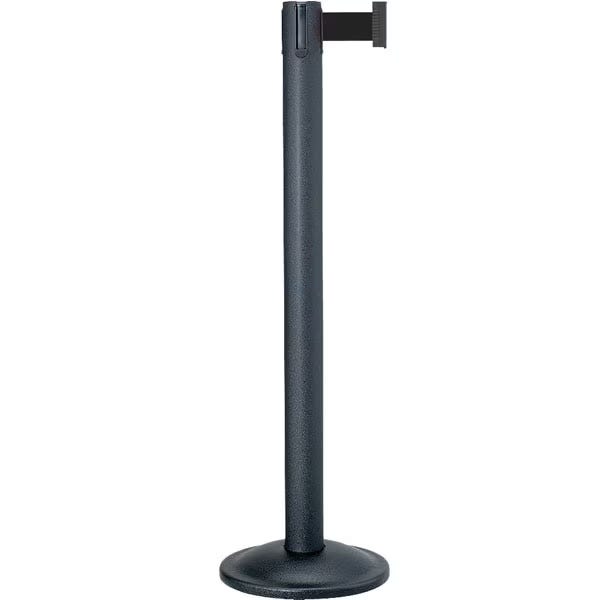
Now, eight months ago, I couldn’t even tell you what this thing is called. A rope? A post? A post with a rope? A blocky thingy? I didn’t know, and what’s more, it didn’t matter. But then, when I started as a CBS Page over the summer, I was forced to confront this bad boy head-on. When my boss referred to the stanchions, I put a name to the face I’d seen at concerts, in dining hall lines, at baseball games, or in the mall.
A lot of my job at CBS was about audience coordination, and a lot of audience coordination is about stanchions.
Audience coordination is essentially herding people like a sheepdog in a headset. It’s being the magical fairy who decides if people can go to the bathroom (no) and if they can go inside, out of the rain (yes! in two hours). It’s customer service meets showbiz. Ish.
The only way to effectively direct 400+ people into a space without complete chaos is to lead them through a rat maze of stanchions or lock them into a pen of plastic and polyester. And you don’t think about it as you walk through them, but someone has to set those stanchions up at the top of every shift and break them down at the end. Someone has to lift (or more realistically, roll) them into place from a dusty closet, put them in place, and connect them. Stanchion work is thankless work. You barely even notice them, but you follow their lead. Because when people see this, they, as the kids would say, understand the assignment.
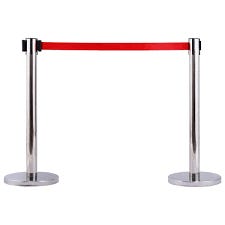
When I was about six months into being a Page, I realized that stanchions were beginning to rule my life. I lifted and placed them every single day. I saw them appearing in my dreams. I noticed them in places they’d usually go unnoticed. I could identify a newer model Uline over an older, heavier Electriduct from twenty feet away. Just as I used to long for the day I’d never bus a table again, I began to long for the day when I just walked around the stanchions, pretending not even to know their names. But now that my time with them is over, I realize the lesson they carry.
When I left CBS and came off of eight months of handling stanchions every day, I was a stanchion hater. I was so annoyed by them, so put out to have been the one carrying them and setting them up. I had a bad taste in my mouth. But when I thought about how I’d write about them, I realized I do actually subscribe to their influence, and so do you.
Whenever I saw a guest blow by a stanchion, I’d be taken aback—like all the way aback. That person could have just spit in my face or stomped on my foot to get their point across. My Pages and I would clutch our pearls, shocked by this transgression.
But that’s because the level of respect that these little fuckers command is tremendous. A stanchion, or a group of stanchions, gets its idea across instantaneously, commanding within one second of looking at it its fundamental, essential thesis:
Don’t.
Not even “do not,” just don’t.
Don’t go over there. Don’t go through there. Don’t even think about it. Don’t.
The tranquil power of a stanchion is like that of a ninja or a mountain. When we see a stanchion, we understand and listen. If we bypass a stanchion, ducking under the rope or, heavens, unclipping the plastic, we know we’re breaking the rules.
And the stanchion is the embodiment of that powerful brevity. It’s not a sign that says, “Please don’t go through here,” or “Go around,” or “Access forbidden.” Stanchions are above words, above language. They look down on the banal, rudimentary ways of verbal communication.
As I was writing this piece, I realized not only are those little effers everywhere, they’re holding everything down. They’re distinguishing us from one another and keeping us in check. They’re separating the 300 people in line for the new Uniqlo in Williamsburg on a Friday morning from the people with jobs. They’re keeping the VIPs in a VIP area in a way that is a little physical but mostly spiritual. I even ran into a stanchion at the bar last weekend and had to pay my respects and buy it a beer. They’re the unsung heroes of society, the pillars of regulation and order.
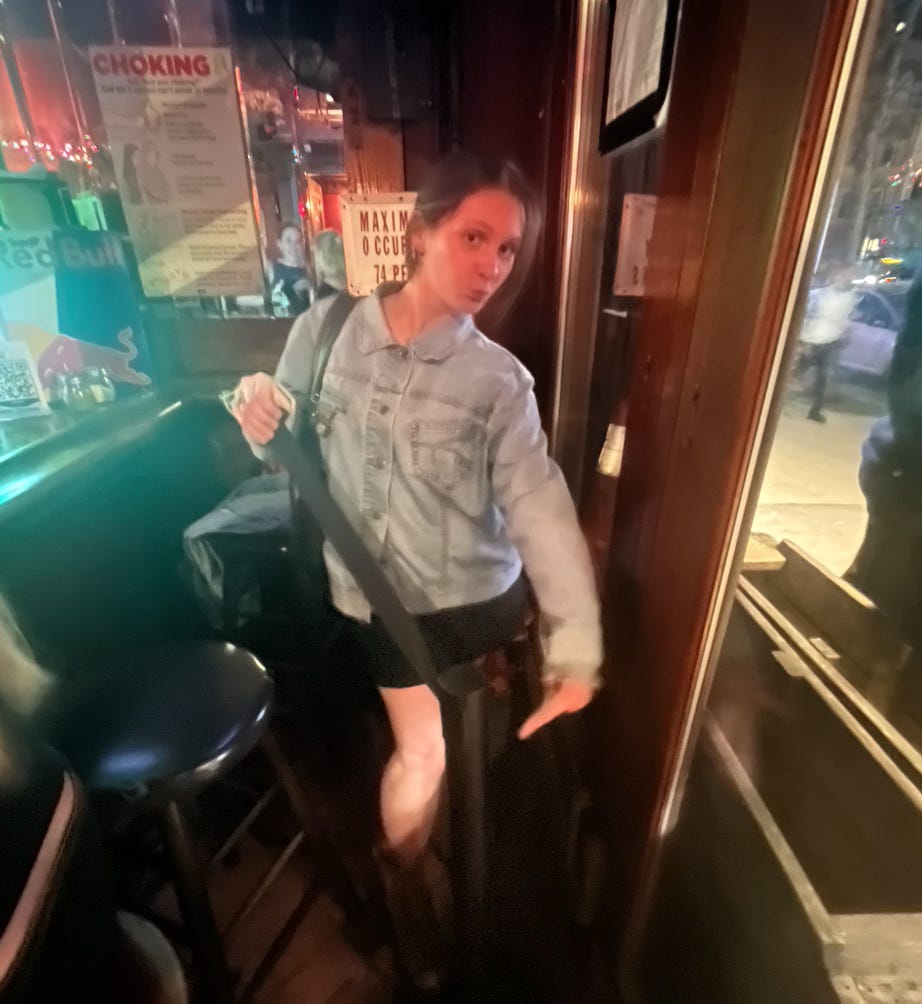
The reverence I have for these objects is, yeah, maybe a symptom of a larger mental issue. But it is also something that I will carry with me and attach new arbitrary meaning to, which is something I love to do.
As I mentioned, I left CBS last month to “pursue the next chapter of my career” (I got a way better, stanchion-less job). That means, for the second time in the past twelve months, I’m new again, learning the ropes of a new job, a new office, new coworkers, and a new favorite bathroom stall. I have once again shaken up my life, jumped up into possibility, and landed somewhere brand new. I love to do that—I live to do that—but it’s challenging.
Despite the newness, I’m confident in myself. But how do I make sure that all gets translated? How do I get my confidence across without tipping in either fatal direction, to insecurity or overconfidence? I’m always trying to explain myself, but how do I explain who I am, what a good job I want to do, and get all of my ideas across without just going on and on and on and on…?
I think I look to the stanchion. I look at its upright posture, its steady conviction, and its ability to communicate briefly and effectively. I think I let my actions speak for me, right? Isn’t that what those guys do?
You know that George RR Martin quote that’s like “A lion does not concern itself with the opinion of sheep”? Well, the stanchion also does not concern itself, period. It’s not concerned; it stands on. Nevertheless, it persists.
So thank you to the stanchions. Thanks for literally controlling the entire world. Also, a big shoutout to the fences, the folding screens, the gates, the dunes, the doors, the tall grasses and shrubs, and whatever other stuff is keeping people where they’re supposed to be.
And finally, thanks for reminding me that sometimes the greatest impact can come from the fewest words. Though I actually don’t think I’ll ever fully be able to say the fewest words. I think a brief, concise piece still looks something like this. Actually, maybe I should delete this whole thing. A stanchion would never write an essay.
Shoutouts go to…
Sam for edits and calling out my apparent hate of quotation marks.
And my squad of CBS Pages. Love you mothereffers bad. This essay is fo you.
As a Canucks fan, I have a deep affinity for stanchions, and this has deepened that, so thank you.
I will forever think of this essay when I see a stanchion. Brilliant.